
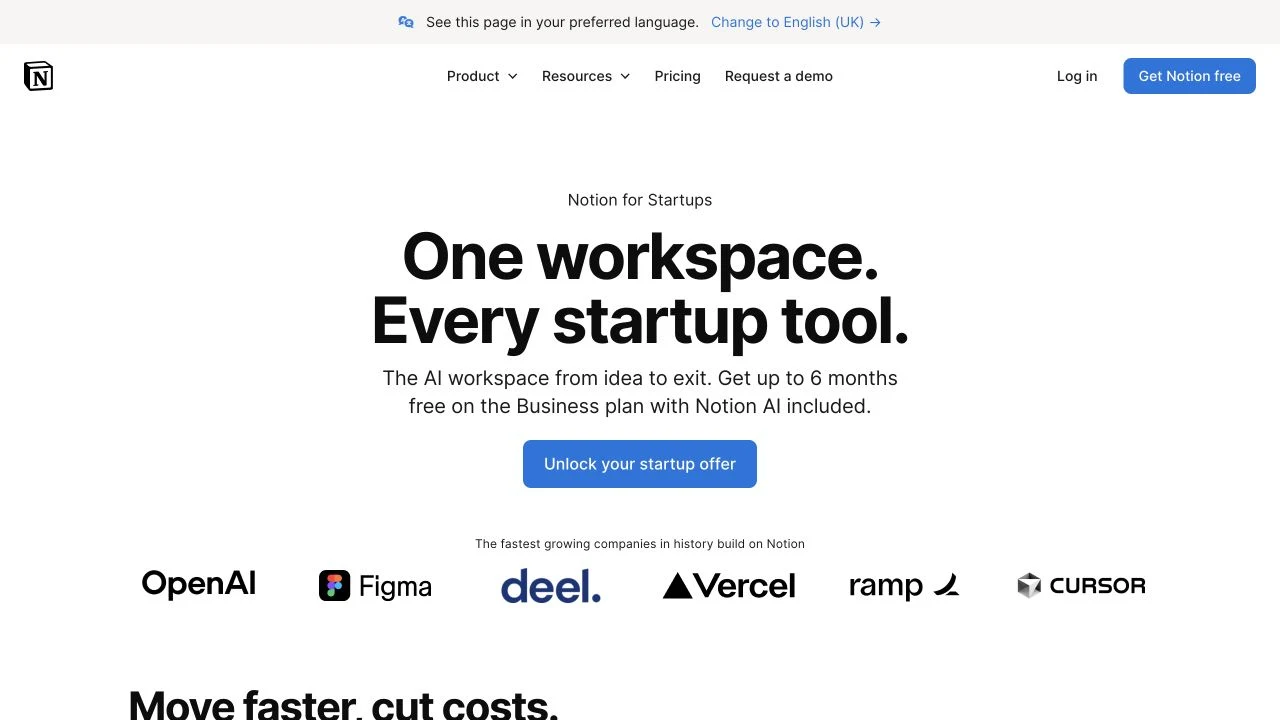
Cover: Notion’s startup program page, captured October 16, 2026.
Notion can give an early-stage startup one place for notes, databases and decisions. Start small: connect customer evidence to the experiments it informs. A solo founder can build that manual workflow on Free; collaboration limits and ongoing AI use may change the plan you need.
If you’re looking for the Notion for Startups offer, it currently advertises up to six free months of Business, including monthly AI credits. Eligibility determines whether the offer is one, three or six months. Check those conditions before budgeting for it.
Already have a workspace? Jump to the copyable starter outline and database setup.
Is Notion good for startups?
Consider Notion when your team needs to keep source material beside the work it informs: customer notes linked to a test, a product brief beside its tasks, or a decision with its supporting documents. The useful feature is the connection between records, not the number of dashboards you can build.
Keep specialist tools where the job requires them. A flexible database does not automatically become accounting software, a support queue or a production application backend. If your existing tool already handles the workflow well, moving it into Notion adds maintenance rather than an obvious benefit.
Turn scattered notes into a decision you can explain.
Which Notion plan does a startup need?
| Plan | Monthly billing | Annual billing | Relevant fit |
|---|---|---|---|
| Free | $0 | $0 | Manual solo workspace; limited AI trial. |
| Plus | $12/member/month | $10/member/month; $120/member/year | Team collaboration; AI remains a limited trial. |
| Business | $24/member/month | $20/member/month; $240/member/year | Notion AI and granular database permissions. |
| Enterprise | Custom | Custom | Additional administration and security controls. |
Free has unlimited pages and blocks for individuals, but collaborative blocks are limited with two or more members. Uploads are limited to 5 MB per file and there are ten guest slots. Guests access invited pages; adding a paid member creates a different billing commitment.
Annual figures are per-member commitments, not month-to-month prices. Currency, taxes and workspace availability can differ. Check Notion’s pricing page and the actual checkout before upgrading.
How the Notion startup offer works
The official startup program is a temporary Business-plan offer, separate from the permanent Free plan:
| Advertised offer | Who should check it |
|---|---|
| 6 months | Eligible non-paying startups affiliated with a selected Notion startup partner. |
| 3 months | Eligible non-paying startups without that partner affiliation. |
| 1 month | Smaller teams under ten employees, SMBs or service businesses may receive this tier; incomplete company information can also lead to one month. |
Notion asks for a company website, a work-domain email and fewer than 100 employees. The three- and six-month tiers target scalable technology-related products or services. Prior promotions, a paid account or previously paid history can affect eligibility; use the current program requirements and confirm your situation with Notion.
A six-month partner code must come from your actual eligible partner. Approval and the offer length belong to Notion; there is no Superfounder code promised here. Before accepting, check what happens when the offer ends and what the workspace will cost afterward. The offer includes the applicable monthly Business AI allowance, not an unlimited balance for every model or autonomous task. Check the approved workspace’s actual allowance and any separately funded Notion credits.
Build an evidence-to-decision workspace
Keep customer sources beside the decisions they inform. This starter uses two databases and works manually.
1. Add the starter page
Create a Notion page named “Founder evidence and decisions”. Paste this outline into its body; it adds text only.
Current decision
What do we need to decide, and which assumption matters most?

Evidence database
Add sources and source notes. Separate observations from interpretations.

Experiments database
Connect the relevant evidence to one planned test.

Review notes
What did we observe? What should we continue, change or stop?
2. Create the databases
Create two databases named Evidence and Experiments. Add the properties below, but create the Relation pair in step 3. Open an Evidence row as a page to keep its source notes or observed actions in the body.
| Property | Type | Use |
|---|---|---|
| Evidence | Title | A short source or question label. |
| Record type | Select | Research plan, Assumption or Observation. |
| Source | Text | Link, document reference or “Unverified assumption”. |
| Source date | Date | When the source was produced; leave unknown dates blank. |
| Context | Text | Who, situation and relevant conditions. |
| Interpretation | Text | Your inference, separate from source notes. |
| Follow-up | Text | The next question or action. |
| Related experiments | Relation | The return link created in step 3. |
| Property | Type | Use |
|---|---|---|
| Experiment | Title | A specific test name. |
| Assumption | Text | The claim being tested. |
| Decision rule | Text | Signal, denominator, time window and next decision. |
| Owner | Person | Person responsible. |
| Status | Select | Planned, Running or Reviewed. |
| Review date | Date | When to review actual observations. |
| Related evidence | Relation | Create this Relation in step 3. |
| Observations | Text | Actual actions and counts after the test. |
| Decision | Text | Your choice and its supporting evidence. |
3. Connect a source to a test
In Experiments, create Related evidence as a Relation to Evidence. Enable its reciprocal property in Evidence and name it Related experiments. Connect records manually; pasted text or CSV imports do not create Relation properties.
Synthetic starter records - not customer evidence: Add “Invoice-reminder repeat-use question” to Evidence. Set Record type to Research plan, Source to “Unverified assumption”, and Follow-up to checking eligibility. Leave Source date blank.
In Experiments, add “Manual reminder pilot - NOT RUN”. Link the evidence record, set Status to Planned, and choose an owner and review date when scheduling. The hypothetical rule is at least three of the five qualified volunteers each request a second eligible invoice use within 14 days. This is a planning choice, not statistical proof or payment demand. Leave Observations empty and Decision as “Pending actual observations”.
You should see: an Evidence record linked to its planned experiment, with the return link visible in Evidence. After running the test, add actual observations before recording a decision.
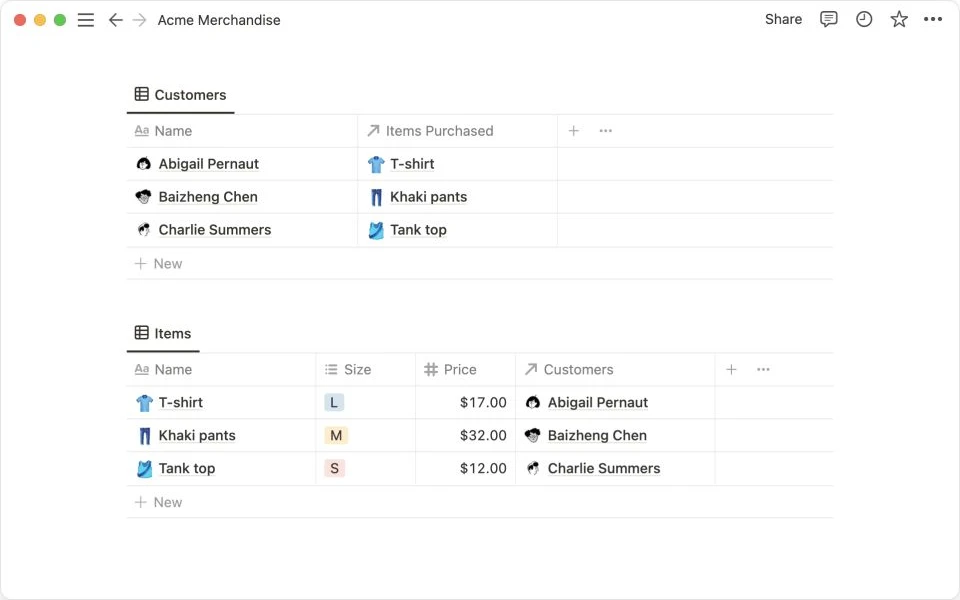
A Relation connects database pages. To make the return link, enable Show on the related database during setup. This lets you open the source from an experiment and the experiment from its source. A count of linked notes is not a count of distinct customers or evidence of demand.
4. Make the next review visible
Create an Evidence view filtered to records that still need follow-up. In Experiments, add a board grouped by Status and a view sorted by Review date. These are different views of the same records, so you do not need a second copy of each experiment.
For the hypothetical reminder pilot, qualified volunteers are freelancers with at least two overdue invoices they expect to follow up during the next 14 days. They review and send reminder drafts themselves. The record is a plan: it contains no real customer observations. For the full test design, use the Lean Startup experiment guide.
Where Notion AI helps this workflow
Business and Enterprise include ongoing Notion AI usage with allowances; Free and Plus provide limited trials. The startup offer includes monthly AI credits for the approved Business workspace, but does not remove feature-specific usage limits. Choose an upgrade from the step you actually need:
| Feature | Useful input and output | What you still check |
|---|---|---|
| Basic Autofill | Summarize or tag the content of one Evidence page. | It cannot search other pages or the web. Verify the summary against the original note. |
| Notion Agent | Work with selected permitted pages; draft a comparison of the notes you supply. | Review sources and edits. Do not ask it to invent interview evidence or make the founder’s decision. |
| Enterprise Search | Retrieve cited answers from Notion and configured connected apps. | Check citations and connector scope. Despite its name, it is also available on Business; pricing labels it beta. |
| AI Meeting Notes | Transcribe and summarize an interview after participants consent. | Check the transcript and sharing. Desktop can capture system audio; browser/mobile capture differs and may miss remote voices. |

Basic Autofill and Custom Agent Autofill are different. Basic Autofill is included on Business and Enterprise and does not use Notion credits. It reads the individual row or page. Custom Agent Autofill can use broader context; the feature documentation specifies Notion-credit usage. For this starter workflow, a manually written summary is enough.
Current AI allowances, checked October 25, 2026: Notion’s credit documentation describes a standard monthly allocation of 1,500 Standard and 500 Select credits per member. Included amounts may vary by plan and purchase arrangement; check Settings → Notion AI → Usage for your workspace. The new system starts October 19 for new Business and Enterprise workspaces, and November 2 for existing ones.
Agent on Auto uses Standard credits. Supported manually selected models use Select; high-credit-consumption models require separately funded Notion credits. Standard and Select are separate per-member balances: they cannot be combined or transferred, and unused credits do not roll over. If one runs out, affected work pauses until reset unless an admin enables eligible continued usage from funded workspace Notion credits.
Under the new system, a regular Custom Agent uses its owner’s Select credits by default, even when shared, unless an admin funds it directly with Notion credits. Agents created before November 2, 2026 continue drawing from shared workspace credits. The current eligibility table says AI Meeting Notes begins using Standard credits on December 1, 2026, while Workers uses no credits during beta. Check the individual feature and funding source before enabling automatic work.
For the plan and workspace decision, read the Notion review. The Notion AI profile explains the per-member budget with an illustrative example; the manual database setup works without those AI features.
For an optional per-page summary, use this instruction with notes you are permitted to process:
Summarize this source note in three short parts:
1. What the source actually states or what was observed.
2. What remains unknown.
3. One follow-up question.

Do not invent quotes, counts, customer actions or conclusions about demand. Keep assumptions separate from observations.
The steps above are a manual setup blueprint based on current documentation. The screenshots are Notion’s demonstrations; we have not tested this workflow or its AI outputs in an authenticated workspace.
Keep customer sources private
A filtered view or a hidden column is not an access restriction. Check page and database sharing before adding research. Keep raw sources with the appropriate people and share a redacted decision summary when others only need the outcome. Granular database controls require Business or Enterprise.
Personal Agent follows the user’s permissions, while Custom Agents can have their own resource access. A shared agent can expose information from resources it can read. Review that scope before connecting sensitive research; an autonomous agent is not required for this setup.
Put one real decision through the system
Start with one source you already have permission to use. Record its date and context, separate observation from interpretation, and link it to one planned experiment. At the review, write what happened and why it changes—or supports—your next step.
You do not need a paid “Startup OS” to begin. Add a larger template only when it solves a recurring job that this small system cannot handle. A good workspace makes the next decision easier to explain; it does not replace the customer work behind it.

Affiliate Disclosure: Some of the links in this article may be affiliate links, which can provide compensation to me at no cost to you if you decide to purchase a paid plan. This site is not intended to provide financial advice and is for entertainment only. As an Amazon Associate I earn from qualifying purchases.